
Few decisions couples make for their wedding carry more emotional weight than the music. The song playing as someone walks down the aisle, the melody of the first dance, the track that fills the floor at midnight — these choices are rarely accidental. They are small declarations: of taste, of memory, of what the couple wants this day to mean. Behind that instinct lies a tradition stretching back thousands of years.
The use of music in wedding ceremonies predates written history. In ancient Greece, weddings were communal events that moved through the city in procession, accompanied by specific songs tied to each ritual stage. The Hymenaios — a wedding hymn named after the god of marriage ceremonies — was sung as the bride was escorted to her new home. The music was not decoration; it marked the threshold between one life and another.
In ancient Mesopotamia and Egypt, music accompanied religious ceremonies of all kinds, and marriage was among the most significant. Instruments varied by culture and region — flutes, lyres, drums — but the underlying function was consistent: music sanctified the moment and connected it to something larger than the two people involved.
Through the medieval period in Europe, the pipe organ became the dominant voice of Christian ceremony. Its capacity to fill an entire building with sustained sound made it uniquely suited to marking the weight of a vow. The processional marches that still open many modern ceremonies — most famously Wagner's Bridal Chorus and Mendelssohn's Wedding March — both date from the nineteenth century, yet they carry the accumulated authority of this much longer tradition.
One of the most striking things about wedding music across cultures is how consistent the underlying logic is, even when the sounds are entirely different.
In traditional Indian weddings, music accompanies every stage of a multi-day ceremony. The dhol drum drives the baraat procession as the groom arrives, and specific ragas are performed at different times of day, each associated with particular emotional qualities. Bhangra — a folk dance style that became widely popular in the 1950s — is now a fixture of Punjabi wedding receptions, blending heritage with celebration in a way that feels both rooted and alive.
Greek weddings have their own processional tradition, with guests and the wedding party dancing together to Orea Pou Ine Nifi Mas — roughly translated as "How Beautiful the Bride Is." The accompanying dance, the Kalamatiano, is one of the oldest continuously performed folk dances in Europe, with references that some scholars trace as far back as Homer.
Irish wedding music tends toward lively jigs and fiddle melodies that dissolve the boundary between ceremony and celebration. In many African traditions, wedding songs serve as a form of communal instruction — conveying lessons about marriage, shared values, and responsibilities through lyrics that the entire community sings together.
What connects all of these is the sense that music does something words alone cannot. It gathers people into a shared emotional state and marks the moment as one worth remembering.
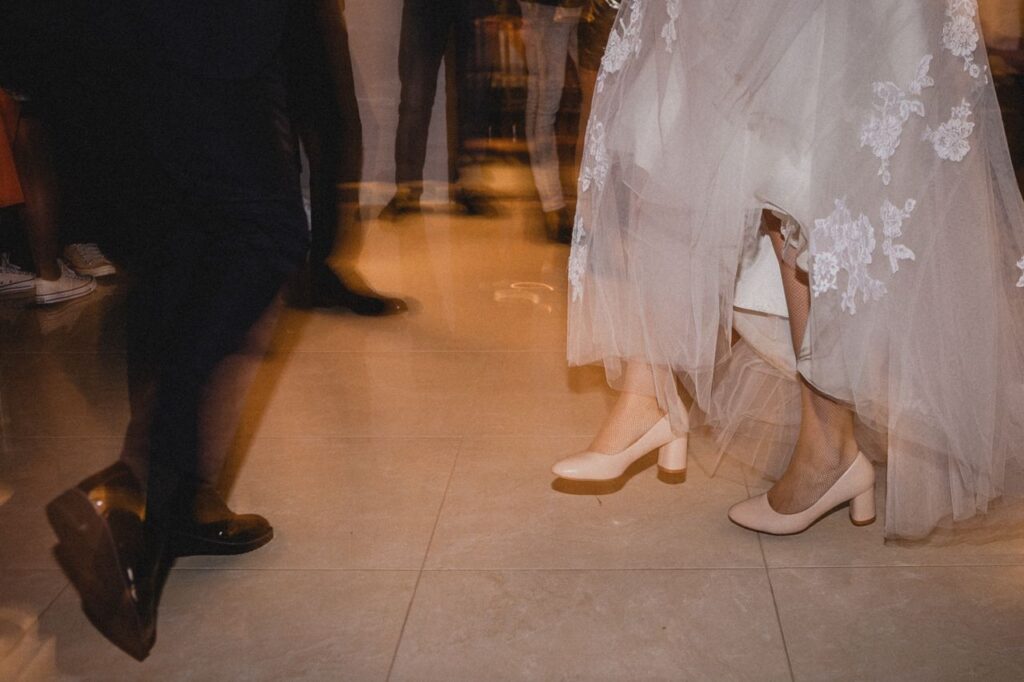
The first dance as a distinct wedding ritual is relatively recent. It began to take shape during the jazz age of the 1920s and 1930s, when live big band music became a feature of reception celebrations and the idea of a couple dancing together as a symbolic act gained cultural traction. Songs like "At Last" by Etta James — recorded in 1960 but rooted in earlier jazz and blues traditions — became standards of this repertoire and remain among the most requested wedding songs today.
From the 1960s onwards, the expansion of popular music gave couples an ever-wider vocabulary to draw from. Beatles ballads, Motown classics, and later rock anthems entered the wedding repertoire alongside classical pieces and jazz standards. The logic shifted: rather than choosing from a shared cultural canon, couples increasingly selected songs that were personally meaningful — music from a first date, a favourite album, a moment in a relationship that needed marking.
This personalisation has only deepened with streaming. Couples now arrive at their wedding planning with carefully curated playlists that reflect specific moods, memories, and aesthetic choices. The ceremony entrance, cocktail hour, dinner, and dancing each receive separate musical consideration.
It is worth being clear about why music matters so much at weddings, beyond sentiment.
Music controls time. A slow processional stretches a moment that would otherwise pass in seconds. A high-tempo reception playlist compresses hours into something that feels like it ended too soon. Couples and their guests often describe wedding days as simultaneously the longest and shortest of their lives — and the music is doing much of that temporal work.
Music creates shared experience. When everyone in a room hears the same thing at the same moment, they are briefly united. This is what ancient processional songs and modern dance floors have in common: they turn a collection of individuals into a temporary community gathered around a specific joy.
Music carries cultural memory. Choosing a song that belonged to a grandparent, or that comes from a specific regional tradition, is a way of including people who cannot be present, or of connecting the new relationship to the longer story of a family or community.
As wedding music researchers have noted, songs chosen for ceremonies function as culturally embedded texts that transmit values, identity, and social memory across generations — a function that has remained remarkably stable even as the specific music has changed beyond recognition.
There are no rules about what wedding music should be. The tradition is old enough and broad enough to accommodate almost anything. What matters is that the choices feel intentional — that the music is doing something specific, marking something real, rather than simply filling silence.
The processional sets the emotional tone for everything that follows. The first dance is a performance of the relationship for the people who care most about it. The final song of the night is the last thing guests will carry home. None of these moments need to be conventional. They just need to mean something to the people choosing them.
That, in the end, is what wedding music has always been for.
For most of its history, video game music existed in a peculiar limbo — noticed by players, loved by fans, and largely ignored by the wider music world. That has changed. Today, game soundtracks sell out concert halls, top classical charts, and compete at the Grammy Awards. The path from 8-bit bleeps to full orchestral scores is one of the more interesting stories in contemporary music.
Early video game music was not an artistic choice — it was a technical constraint. The hardware of the late 1970s and 1980s could generate only a handful of simultaneous audio channels, which meant composers had to create something memorable within severe limitations. Koji Kondo's themes for Super Mario Bros. and The Legend of Zelda, Nobuo Uematsu's work across the Final Fantasy series, and Yuzo Koshiro's compositions for Streets of Rage all became iconic not despite their constraints but partly because of them. The limitations forced economy of means and melodic clarity that stuck.
The chiptune aesthetic born from this era has since become a genre in its own right, with contemporary artists deliberately composing in that style long after the hardware limitations disappeared. What started as a workaround became an aesthetic.
As processing power increased through the 1990s and 2000s, composers gained access to recorded instruments, larger orchestras, and eventually full cinematic audio production. The music grew more complex, but the underlying challenge remained: game music must function differently from film scores or albums. It loops. It responds to player decisions. It sustains tension across sessions that might last hours. These demands pushed composers to develop techniques that have no direct equivalent in any other medium.
The formal recognition of video game music as a serious discipline arrived slowly and then quickly. Austin Wintory's score for Journey received a Grammy nomination for Best Score Soundtrack for Visual Media in 2013 — the first time a video game score had been acknowledged by the Recording Academy. A decade later, the Academy created a dedicated category.
The Grammy Award for Best Score Soundtrack for Video Games and Other Interactive Media was introduced at the 65th Grammy Awards in February 2023. The first winner was Stephanie Economou for Assassin's Creed Valhalla: Dawn of Ragnarok. Since then, the category has attracted composers who have worked across film, television, and concert music — reflecting how thoroughly the boundary between game scoring and other forms of composition has dissolved.
The 2026 Grammy in this category went to Austin Wintory for Sword of the Sea, with nominees including Avatar: Frontiers of Pandora, Helldivers 2, Indiana Jones and the Great Circle, and Star Wars Outlaws. The names attached to these scores — Pinar Toprak, Gordy Haab, Wilbert Roget II — are the same composers working on major film and television productions.
One measure of how seriously audiences take game music is what happens when it leaves the screen. Video Games Live, a touring concert series featuring orchestral performances of game soundtracks, launched in 2005 and has since performed in over 40 countries. Nobuo Uematsu's Final Fantasy concerts regularly sell out large venues. The Legend of Zelda: Symphony of the Goddesses has toured continuously since 2012.
On streaming platforms, the numbers tell a similar story. Game soundtracks appear consistently on Spotify's most-streamed classical and instrumental playlists. The soundtrack for Clair Obscur: Expedition 33, composed by Lorien Testard, reached number one on Billboard's Classical chart and held the position for ten weeks following the game's 2025 release — an achievement that would have seemed implausible for a video game score a decade earlier.
For listeners discovering this music through curated digital entertainment platforms — the kind of services that aggregate reviews, recommendations, and bonus content across different entertainment categories, such as bonus-jaeger.de — game soundtracks now sit alongside film scores and contemporary classical releases as part of a broader cultural conversation about what counts as serious music.
This shift is documented in detail by the Recording Academy, whose dedicated Grammy category for video game scores tracks the genre's growing institutional recognition year by year.
The compositional demands of video game music are genuinely different from those of other scored media, and understanding those differences helps explain why the genre has developed its own techniques and aesthetics.
Film and television scores are composed to picture — the timing of musical events is fixed to match what appears on screen. Game scores must be adaptive. A player might spend three minutes or thirty minutes in the same environment, which means the music must sustain without becoming repetitive. Combat might begin at any moment, requiring a seamless transition from ambient exploration music to something that communicates urgency.
These requirements have produced compositional approaches that are now studied in music schools:
Composers like Christopher Tin, whose work spans classical albums, film scores, and games, have spoken about how game scoring forced them to think about music in fundamentally new ways. The medium's interactivity demands a different relationship between composer and listener — one where the music responds to behaviour rather than simply accompanying a fixed narrative.
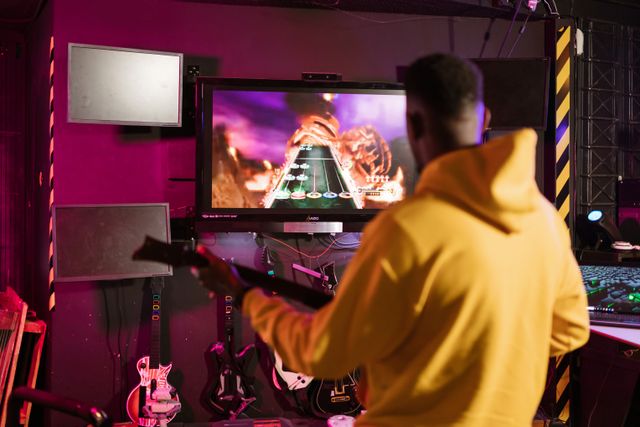
One of the clearest signs of game music's maturity is the calibre of composers now working in the medium. Hans Zimmer, Michael Giacchino, Harry Gregson-Williams, and Bear McCreary have all scored major game titles alongside their film and television work. The traffic moves in both directions: composers who built their careers in games, like Nobuo Uematsu and Koji Kondo, are recognised as significant figures in twentieth-century music more broadly.
This crossover has accelerated in recent years as game budgets have grown to rival film productions. Major titles now allocate substantial resources to original scores recorded with full orchestras, often at prestigious studios with the same production values applied to Hollywood films. The result is music that stands independently of its source — something that can be listened to, performed live, and appreciated without any knowledge of the game it accompanied.
| Composer | Known game work | Background |
| Nobuo Uematsu | Final Fantasy series | Self-taught; primarily game composer |
| Christopher Tin | Civilization IV, Old World | Classical and crossover albums |
| Bear McCreary | God of War, Battlestar Galactica | Television and games |
| Pinar Toprak | Avatar: Frontiers of Pandora | Film and game scoring |
| Austin Wintory | Journey, Sword of the Sea | Concert, film, and games |
Video game music did not become a serious genre because critics decided it should be taken seriously. It became one because composers treated it seriously from the beginning, because players formed genuine emotional attachments to it, and because the technical and artistic demands of the medium pushed composers to develop techniques that have enriched music more broadly.
The Grammy category, the sold-out concert halls, the chart positions — these are recognition of something that was already happening. Game soundtracks occupy a permanent place in contemporary music culture, and the composers working in the medium are among the most technically inventive in any field.