
Few decisions couples make for their wedding carry more emotional weight than the music. The song playing as someone walks down the aisle, the melody of the first dance, the track that fills the floor at midnight — these choices are rarely accidental. They are small declarations: of taste, of memory, of what the couple wants this day to mean. Behind that instinct lies a tradition stretching back thousands of years.
Music and Marriage: An Ancient Connection
The use of music in wedding ceremonies predates written history. In ancient Greece, weddings were communal events that moved through the city in procession, accompanied by specific songs tied to each ritual stage. The Hymenaios — a wedding hymn named after the god of marriage ceremonies — was sung as the bride was escorted to her new home. The music was not decoration; it marked the threshold between one life and another.
In ancient Mesopotamia and Egypt, music accompanied religious ceremonies of all kinds, and marriage was among the most significant. Instruments varied by culture and region — flutes, lyres, drums — but the underlying function was consistent: music sanctified the moment and connected it to something larger than the two people involved.
Through the medieval period in Europe, the pipe organ became the dominant voice of Christian ceremony. Its capacity to fill an entire building with sustained sound made it uniquely suited to marking the weight of a vow. The processional marches that still open many modern ceremonies — most famously Wagner's Bridal Chorus and Mendelssohn's Wedding March — both date from the nineteenth century, yet they carry the accumulated authority of this much longer tradition.
How Different Cultures Use Wedding Music
One of the most striking things about wedding music across cultures is how consistent the underlying logic is, even when the sounds are entirely different.
In traditional Indian weddings, music accompanies every stage of a multi-day ceremony. The dhol drum drives the baraat procession as the groom arrives, and specific ragas are performed at different times of day, each associated with particular emotional qualities. Bhangra — a folk dance style that became widely popular in the 1950s — is now a fixture of Punjabi wedding receptions, blending heritage with celebration in a way that feels both rooted and alive.
Greek weddings have their own processional tradition, with guests and the wedding party dancing together to Orea Pou Ine Nifi Mas — roughly translated as "How Beautiful the Bride Is." The accompanying dance, the Kalamatiano, is one of the oldest continuously performed folk dances in Europe, with references that some scholars trace as far back as Homer.
Irish wedding music tends toward lively jigs and fiddle melodies that dissolve the boundary between ceremony and celebration. In many African traditions, wedding songs serve as a form of communal instruction — conveying lessons about marriage, shared values, and responsibilities through lyrics that the entire community sings together.
What connects all of these is the sense that music does something words alone cannot. It gathers people into a shared emotional state and marks the moment as one worth remembering.
The Modern First Dance and Its Meanings
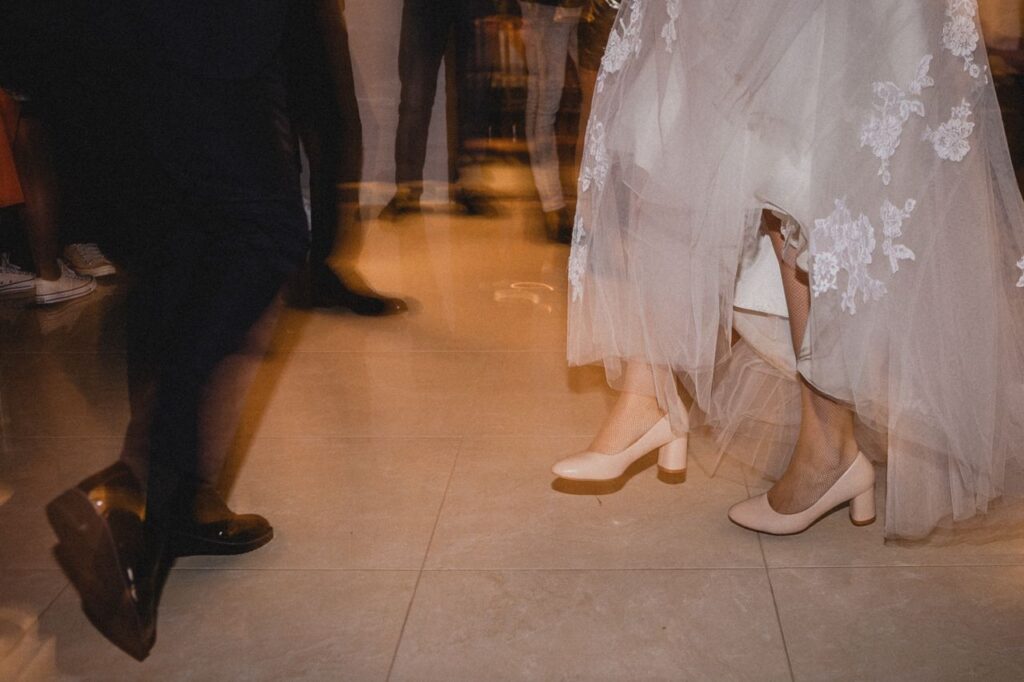
The first dance as a distinct wedding ritual is relatively recent. It began to take shape during the jazz age of the 1920s and 1930s, when live big band music became a feature of reception celebrations and the idea of a couple dancing together as a symbolic act gained cultural traction. Songs like "At Last" by Etta James — recorded in 1960 but rooted in earlier jazz and blues traditions — became standards of this repertoire and remain among the most requested wedding songs today.
From the 1960s onwards, the expansion of popular music gave couples an ever-wider vocabulary to draw from. Beatles ballads, Motown classics, and later rock anthems entered the wedding repertoire alongside classical pieces and jazz standards. The logic shifted: rather than choosing from a shared cultural canon, couples increasingly selected songs that were personally meaningful — music from a first date, a favourite album, a moment in a relationship that needed marking.
This personalisation has only deepened with streaming. Couples now arrive at their wedding planning with carefully curated playlists that reflect specific moods, memories, and aesthetic choices. The ceremony entrance, cocktail hour, dinner, and dancing each receive separate musical consideration.
What Wedding Songs Actually Do
It is worth being clear about why music matters so much at weddings, beyond sentiment.
Music controls time. A slow processional stretches a moment that would otherwise pass in seconds. A high-tempo reception playlist compresses hours into something that feels like it ended too soon. Couples and their guests often describe wedding days as simultaneously the longest and shortest of their lives — and the music is doing much of that temporal work.
Music creates shared experience. When everyone in a room hears the same thing at the same moment, they are briefly united. This is what ancient processional songs and modern dance floors have in common: they turn a collection of individuals into a temporary community gathered around a specific joy.
Music carries cultural memory. Choosing a song that belonged to a grandparent, or that comes from a specific regional tradition, is a way of including people who cannot be present, or of connecting the new relationship to the longer story of a family or community.
As wedding music researchers have noted, songs chosen for ceremonies function as culturally embedded texts that transmit values, identity, and social memory across generations — a function that has remained remarkably stable even as the specific music has changed beyond recognition.
Choosing Music That Means Something
There are no rules about what wedding music should be. The tradition is old enough and broad enough to accommodate almost anything. What matters is that the choices feel intentional — that the music is doing something specific, marking something real, rather than simply filling silence.
The processional sets the emotional tone for everything that follows. The first dance is a performance of the relationship for the people who care most about it. The final song of the night is the last thing guests will carry home. None of these moments need to be conventional. They just need to mean something to the people choosing them.
That, in the end, is what wedding music has always been for.