
For most of its history, video game music existed in a peculiar limbo — noticed by players, loved by fans, and largely ignored by the wider music world. That has changed. Today, game soundtracks sell out concert halls, top classical charts, and compete at the Grammy Awards. The path from 8-bit bleeps to full orchestral scores is one of the more interesting stories in contemporary music.
Early video game music was not an artistic choice — it was a technical constraint. The hardware of the late 1970s and 1980s could generate only a handful of simultaneous audio channels, which meant composers had to create something memorable within severe limitations. Koji Kondo's themes for Super Mario Bros. and The Legend of Zelda, Nobuo Uematsu's work across the Final Fantasy series, and Yuzo Koshiro's compositions for Streets of Rage all became iconic not despite their constraints but partly because of them. The limitations forced economy of means and melodic clarity that stuck.
The chiptune aesthetic born from this era has since become a genre in its own right, with contemporary artists deliberately composing in that style long after the hardware limitations disappeared. What started as a workaround became an aesthetic.
As processing power increased through the 1990s and 2000s, composers gained access to recorded instruments, larger orchestras, and eventually full cinematic audio production. The music grew more complex, but the underlying challenge remained: game music must function differently from film scores or albums. It loops. It responds to player decisions. It sustains tension across sessions that might last hours. These demands pushed composers to develop techniques that have no direct equivalent in any other medium.
The formal recognition of video game music as a serious discipline arrived slowly and then quickly. Austin Wintory's score for Journey received a Grammy nomination for Best Score Soundtrack for Visual Media in 2013 — the first time a video game score had been acknowledged by the Recording Academy. A decade later, the Academy created a dedicated category.
The Grammy Award for Best Score Soundtrack for Video Games and Other Interactive Media was introduced at the 65th Grammy Awards in February 2023. The first winner was Stephanie Economou for Assassin's Creed Valhalla: Dawn of Ragnarok. Since then, the category has attracted composers who have worked across film, television, and concert music — reflecting how thoroughly the boundary between game scoring and other forms of composition has dissolved.
The 2026 Grammy in this category went to Austin Wintory for Sword of the Sea, with nominees including Avatar: Frontiers of Pandora, Helldivers 2, Indiana Jones and the Great Circle, and Star Wars Outlaws. The names attached to these scores — Pinar Toprak, Gordy Haab, Wilbert Roget II — are the same composers working on major film and television productions.
One measure of how seriously audiences take game music is what happens when it leaves the screen. Video Games Live, a touring concert series featuring orchestral performances of game soundtracks, launched in 2005 and has since performed in over 40 countries. Nobuo Uematsu's Final Fantasy concerts regularly sell out large venues. The Legend of Zelda: Symphony of the Goddesses has toured continuously since 2012.
On streaming platforms, the numbers tell a similar story. Game soundtracks appear consistently on Spotify's most-streamed classical and instrumental playlists. The soundtrack for Clair Obscur: Expedition 33, composed by Lorien Testard, reached number one on Billboard's Classical chart and held the position for ten weeks following the game's 2025 release — an achievement that would have seemed implausible for a video game score a decade earlier.
For listeners discovering this music through curated digital entertainment platforms — the kind of services that aggregate reviews, recommendations, and bonus content across different entertainment categories, such as bonus-jaeger.de — game soundtracks now sit alongside film scores and contemporary classical releases as part of a broader cultural conversation about what counts as serious music.
This shift is documented in detail by the Recording Academy, whose dedicated Grammy category for video game scores tracks the genre's growing institutional recognition year by year.
The compositional demands of video game music are genuinely different from those of other scored media, and understanding those differences helps explain why the genre has developed its own techniques and aesthetics.
Film and television scores are composed to picture — the timing of musical events is fixed to match what appears on screen. Game scores must be adaptive. A player might spend three minutes or thirty minutes in the same environment, which means the music must sustain without becoming repetitive. Combat might begin at any moment, requiring a seamless transition from ambient exploration music to something that communicates urgency.
These requirements have produced compositional approaches that are now studied in music schools:
Composers like Christopher Tin, whose work spans classical albums, film scores, and games, have spoken about how game scoring forced them to think about music in fundamentally new ways. The medium's interactivity demands a different relationship between composer and listener — one where the music responds to behaviour rather than simply accompanying a fixed narrative.
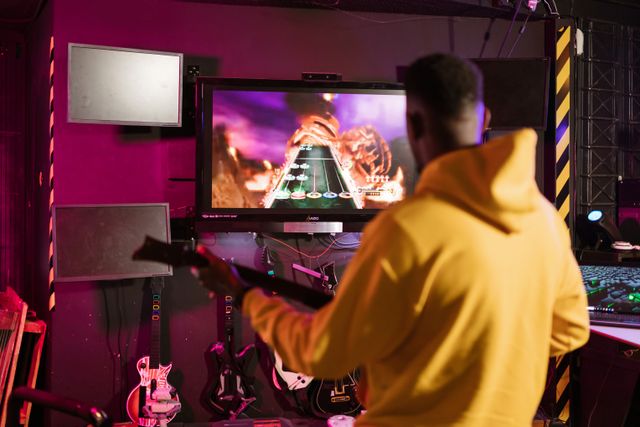
One of the clearest signs of game music's maturity is the calibre of composers now working in the medium. Hans Zimmer, Michael Giacchino, Harry Gregson-Williams, and Bear McCreary have all scored major game titles alongside their film and television work. The traffic moves in both directions: composers who built their careers in games, like Nobuo Uematsu and Koji Kondo, are recognised as significant figures in twentieth-century music more broadly.
This crossover has accelerated in recent years as game budgets have grown to rival film productions. Major titles now allocate substantial resources to original scores recorded with full orchestras, often at prestigious studios with the same production values applied to Hollywood films. The result is music that stands independently of its source — something that can be listened to, performed live, and appreciated without any knowledge of the game it accompanied.
| Composer | Known game work | Background |
| Nobuo Uematsu | Final Fantasy series | Self-taught; primarily game composer |
| Christopher Tin | Civilization IV, Old World | Classical and crossover albums |
| Bear McCreary | God of War, Battlestar Galactica | Television and games |
| Pinar Toprak | Avatar: Frontiers of Pandora | Film and game scoring |
| Austin Wintory | Journey, Sword of the Sea | Concert, film, and games |
Video game music did not become a serious genre because critics decided it should be taken seriously. It became one because composers treated it seriously from the beginning, because players formed genuine emotional attachments to it, and because the technical and artistic demands of the medium pushed composers to develop techniques that have enriched music more broadly.
The Grammy category, the sold-out concert halls, the chart positions — these are recognition of something that was already happening. Game soundtracks occupy a permanent place in contemporary music culture, and the composers working in the medium are among the most technically inventive in any field.
Technology has surely advanced its roots. Due to this, there are many entertaining ways by which you can learn about the skill, technique, and how the business of DJ works. But nothing can be compared to the learning a book provides. So, if you are an astonishing DJ or someone who wants to be in that field here are some essential books that every DJ should read:
Author: Bill Brewster and Frank Broughton
For beginners, the book gives an initial boost. It gives them a practical picture of the artist alongside scientific aspects of the actuality of a DJ. It gives you a closure look diagram throughout to illustrate phrases, beat timing, and song structure with no reliance on music theory. It also tells you about some history.
Author: Bill Brewster and Frank Broughton
This is one of the earliest written and documented books about disc jockeys. It tells you about the life of DJs in detail along with their life happenings. It also tells how DJs have shaped their way through various struggles and outgrown their venture. Furthermore, it elaborates on the tradition of DJ and how clubs responded to that.
Author: Phil White, Luke Crisell, and Rob Principe
On the record is a technical DJ book. You should read it. It tells you about the technical, cultural along business side of DJing. This tells you how to get gigs and create a name for yourself. Moreover, the scratch academy was the first-ever DJ academy all over the US. It’s a guidebook very well bought by the authors and answers all questions starting with “how”.
Authors: DJ Stretch Armstrong, Evan Auerbach
No Sleep by Evan & Stretch is one of the most inspirational books written about DJs. It’s a coffee time book for some motivation and ideas. In such an artistic field inspiration is always very important. It tells you about how it’s like being a DJ in New York City and the club lives through the ’90s. How it evolved and the response of the people to that.
Author: Russell Simmons
This is the autobiography of Russell Simmons. In this, he elaborates about his popular invented hip hop culture and some other popular cultures like pop. He also informs about how global force changed the way people talk, dress, their taste of music, and the choice of their heroes to hang on walls. The book mainly talks regarding people and the advancement of cultural diversity that happened over time.
Author: Peter Hook
This book is about one of the well-known clubs in England ‘The Hacienda’. It tells you the club’s story of how music, gangsters, drugs, and violence led the most successful club to failures. It also talks about famous people who used to perform their gigs at the nightclub. It also laid the tracks of rave culture and today’s electronic dance music that changed the face and sound of modern music.
Author: Mark Katz
This book is an exclusive masterpiece written by Mark Katz, the award holder historian. It emphasizes how today’s hip-hop culture initiated on the streets of New York and raised from there. It also elaborated on the perspective of people who discovered the genre and the stimuli of the masses to it. You should read this book.
Author: Bill Brewster and Frank Broughton
It is the first-hand journal of the vibrant record of the growth of the DJ culture and includes song lists, discographies, and photos of every DJ as a young firebrand. It also talks about how in the sixties radio tastemakers bought these tracks to the masses. Furthermore, it contains interviews of famous DJs of that time which gives a lot of food for thought and certainly is the most wonderful part.
Author: Rick Snoman
The guidebook informs you about upbeat music production. Whether it's designing sounds, adding effects, or mixing tracks. It is packed with scientific and practical tips to help you achieve your professional results. It also elaborates on aspects like layering kicks, rhythm fundamentals, dubstep production, song structure, etc. This also informs regarding the newest techniques of production.
Author: Eliot Wilder
The book is a collaborative masterpiece between a turn-tablist Josh Davis and a master sampler. It is a very inspiring and motivating book that tells us about the broken dreams and the difficulties faced by him. It also emphasizes his initial days in California and his mentors and friends who helped him along the way. This long conversation also emphasizes the genesis and formation of his widely popular book ‘Endtroducing’.
Author: Phil Morse
Whether beginner or sophomore, everyone should read the previously mentioned book. It will enlighten you on what to do to get packed dance floors each night. It provides you a transparent and real guide to enhance your game. It will increase your understanding of the latest DJ gear. It will teach you to assemble the best music collection to perform like a pro and receive better payment eventually.
Author: Laurent Garnier and David Brun-Lambert
This book is one of the bestsellers written by the world-famous Laurent Garnier, a French DJ who is an award-winning recording artist and owner of a label. It includes a captivating record of a dance scenario and his autobiography. It elaborates on famous clubs, influential festivals, and key memories of the history of dance music. Laurent Garnier's story of rags to riches is also very inspiring. He tells about how he felt and dealt with every situation which came in front of him.